Back to All Events

Bay Day

  • Exploratorium Green St SF, CA, 94111 United States (map)

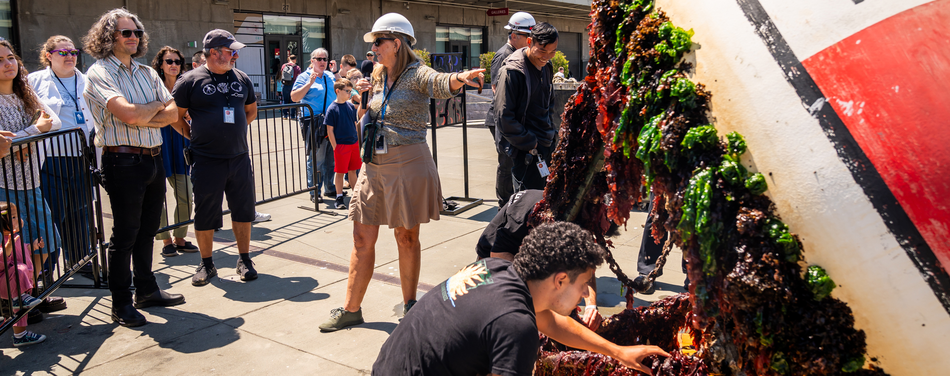
Our annual celebration of the San Francisco Bay and ocean science returns! We’ll be pulling our NOAA data-collection buoy out of the water for its yearly servicing, and have scientists on deck to showcase the fascinating organisms that grow on the buoy and elsewhere in the Bay. Immerse yourself in ocean science and ecology, and join us for a variety of activities for marine enthusiasts of all ages.

About the CO2 Buoy

On loan to us from the National Oceanic and Atmospheric Administration (NOAA), the CO2 buoy has been anchored between Piers 15 and 17 since April 2013, collecting data on water temperature, salinity, and CO2 levels in the atmosphere and the Bay. Every year, we pull it out of the water to calibrate and replace the sensors and to clean off corrosion and marine organisms.

Meet the Buoy

 11:45 a.m.–1:30 p.m.

 Gallery 5: Outdoor Exhibits 

With Mary Miller

Learn all about our data-collection buoy, on loan to us from NOAA, while it is pulled up from the water and prepared for cleaning. Ocean scientist Mary Miller will talk about why it’s important to measure carbon in the Bay, and what carbon capture strategies scientists are trying to slow down climate change.

Mary Miller is a science writer, producer, and former director for the Exploratorium’s partnership with NOAA. She’s spent time with fascinating minds in Antarctica and Greenland, on the NOAA Ship Okeanos Explorer, and at Cold Spring Harbor Laboratory and various NASA facilities.

Buoy Extraction

 12:00 p.m.

 Gallery 5: Outdoor Exhibits 

With Jesse MacQuiddy

Watch a crane hoist our data-collection buoy from the water! The buoy spends its time measuring water temperature, carbon dioxide levels, and salinity in the San Francisco Bay—and accumulating all kinds of fascinating aquatic life. Get a front-row seat to the species that have gathered on its underside over the past year.

Buoy Spa Day

 12:30 p.m.

 Gallery 5: Outdoor Exhibits 

With Jim Pettigrew

Even buoys need some pampering! What instruments does the buoy carry, and how do we keep it clean so that it stays in tip-top shape? Learn about the technical aspects of the buoy from oceanographer Jim Pettigrew.
 
Jim Pettigrew has operated a variety of ocean observing systems for the past 20 years, measuring ocean currents in the Philippines, Prince William Sound, and the coastlines of California and Australia. He has lectured in geography and oceanography for San Francisco State and UC Berkeley.

Creature Feature: Life on the Buoy

 12:00 p.m.

 Gallery 5: Outdoor Exhibits 

With Dana Carrison-Stone

Ever wondered what organisms are living on our data-collection buoy? Staff from our Living Systems Lab will bring their microscopes to our outdoor gallery, and you’ll get a chance to look closely at all the algae and marine invertebrates that have collected on the buoy’s bottom.

Dana Carrison-Stone is Lab Manager at the Exploratorium's Living Systems Lab, the museum's working biology laboratory.

Exploratorium Deep Cuts: Outdoor Exhibits

 11:15 a.m., 1:15 p.m., and 3:15 p.m.

 Gallery 5: Outdoor Exhibits 

With Chris Olson and Jacob Tonski

Our outdoor exhibits are free and open to the public year round, and many of them are hidden in plain sight. Join our exhibit developers for an adventure through our campus on Piers 15 and 17, and visit the exhibits that highlight the science and ecology of the Bay. These are deep cuts from the Exploratorium that you won’t want to miss!

  • Chris Olson holds a masters in physics from the University of Massachusetts and has spent the last 15 years working in labs, museums, makers spaces, and educational nonprofits. He is also a performing musician with a lifelong love of the outdoors.

  • Jacob Tonski is an exhibit developer with a background in computer science and the arts. He joined the Exploratorium in 2023 after 14 years teaching creative art and technology practices in both university and art school settings.

Drawing Marine Life

 1:00, 2:00, and 3:00 p.m.

 Fisher Bay Observatory Gallery 6 

With Gaily Ezer

Observe the intricate details of marine organisms collected from the NOAA buoy, and turn them into art by drawing, sketching, and coloring! This activity invites you to slow down, examine the world like an artist and scientist, and connect with our Bay through your own creative spark.

Gaily Ezer is a multidisciplinary artist who has illustrated several Exploratorium exhibits, including Settling Plate Field Guide. When not drawing or hiking, she works for TriloBio, on a robot that automates biology experiments to improve smaller labs’ access to high quality, repeatable experimentation.

Tools for a Warming Planet

 1–4 p.m.

 Gallery 2: Tinkering 

With Sara Dean and Beth Ferguson

Hosted by the co-creators of Tools for a Warming Planet, this drop-in workshop will empower you to share knowledge and work together for a more sustainable, adaptive, and symbiotic future. Propose a tool of your own to engage the challenges of climate change, and learn how to build a communal toolbox through science, design, art, technology, and activism.

  • Sara Dean is a Bay Area architect and designer whose work investigates how digital technologies can make cities more equitable and adaptable in the face of Anthropocene and capitalism. She is an assistant professor at California College of the Arts and founder of If/Then Studio.

  • Beth Ferguson is an artist and ecological designer whose practice blends industrial design with sustainable transportation, solar engineering, climate resiliency, and public engagement. She is an assistant professor in the department of design at UC Davis, director of Sol Design Lab​, and founding director of the Adapting City Lab

Buoy Matters: Data Collection for a Healthy Ocean

 2-4 p.m.

 Fisher Bay Observatory Gallery 6 

With Mary Miller and Ron Hipschman

Our data-collection buoy on loan from NOAA performs crucial data collection functions right outside the museum. Ocean scientist Mary Miller will talk about why it’s important to measure carbon in the Bay, how ocean chemistry affects organisms like plankton and oysters, and how scientists are trying to slow down climate change through carbon capture strategies.

  • Mary Miller is a science writer, producer, and former director for the Exploratorium’s partnership with NOAA. She’s spent time with fascinating minds in Antarctica and Greenland, on the NOAA Ship Okeanos Explorer, and at Cold Spring Harbor Laboratory and various NASA facilities.

  • Since joining the Exploratorium in 1971, Ron Hipschman has worked as an exhibit developer, author, teacher, and webcast host. In addition to Full-Spectrum Science, Ron hosts the monthly series "Tales from the Periodic Table" on his YouTube channel (http://www.youtube.com/ronhipschman).

The (Not So) Secret Life of Oysters

 11 a.m–4 p.m.

 Gallery 5: Outdoor Exhibits 

With Gary Fleener

Oysters have a rich history as a food source in the Bay Area, and they contribute to the overall health of the Bay ecosystem. Join Dr. Gary Fleener from Hog Island Oyster Company to learn about bivalve biology, shellfish farming, and the ecosystem services provided by these amazing and ancient animals. Touch live oysters and learn the difference between California native oysters and other important species of the world!

Hog Island Oyster Company, launched and nurtured by marine biologists in the waters of Tomales Bay, has been producing premium shellfish since 1983. Dr. Gary Fleener serves as the Director of Science, Education & Policy for the company.

Tiny Glittering Universe: Plankton Showcase

 11 a.m–4 p.m.

With Veronica Johnson

Take a peek into the beautiful and incredibly diverse world of phytoplankton. These microscopic algae provide a food source for a wide range of sea creatures, and while they may be small, they can have large impacts on the food web around them including shellfish, birds, mammals, and humans.

Lifelong learner and lover of the oceans Veronica Johnson was a biologist in the Exploratorium's Bio Lab for nine years where she fostered a phytoplankton fascination.

The Delicate Art of Diatom Arrangements

 11 a.m–4 p.m.

 Gordon and Betty Moore Gallery 4: Living Systems 

With Nate Dube

Enjoy gorgeous, microscopic mosaics made from diatoms, and learn about algae’s enormous impact on the environment.

Diatoms are tiny but powerful—scientists estimate they produce between twenty and fifty percent of the oxygen we breathe. And if that’s not enough, they’re also beautiful, showcasing a variety of delicate geometric shapes. Join artist and scientist Nate Dube to take a close at diatom arrangements and marvel at their intricacies.

Nate Dube is the vice president of the San Francisco Microscopical Society. Their microscopy journey began with an interest in Victorian diatom arranging, and hope to inspire curiosity and make the microscopic world more accessible to all.

Tunicate Tales

 11 a.m.–4 p.m.

 Gallery 5: Outdoor Exhibits 

With Sarah Cohen

Tuni-what? Tunicates! Discover these colorful chordates (also known as sea squirts), which grow beneath our buoy and on many other surfaces beneath the water. Biologist Sarah Cohen will bring fresh tunicate organisms from the docks (both native and invasive species) and show them off up close.

Sarah Cohen, PhD is a professor of biology at San Francisco State University. Most of her work in marine and estuarine settings has asked questions about how life history, physiological, or behavioral attributes of species affect population structure.

DIY Ocean Exploration

 11 a.m–4 p.m.

 Gallery 2: Tinkering 

With Eric Stackpole

Building tools to explore the ocean is for everyone! Join Eric Stackpole, mechanical engineer and marine technology innovator, to learn about DIY gadgets and devices for studying the ocean.

Eric will demonstrate some of his prototypes, and share how you can build something too. Plus, he will talk about how buoys play a vital role in understanding what’s going on in the world’s oceans and climate.

Eric Stackpole is an engineer and ocean explorer. He co-founded OpenROV and now works at Sofar Ocean, developing affordable ocean sensors deployed across the globe. He has participated in expeditions worldwide, including piloting an under-ice ROV in Antarctica, and co-starred on the National Geographic series "OceanXplorers."

Art with Algae: Seaweed Pressing

 11 a.m–4 p.m.

 Gallery 2: Tinkering 

With Facilitators

Start an algae herbarium with this make-and-take activity. Using algae samples taken from the underside of our data-collection buoy—and some professional plant-preservation supplies that we’ll provide—you can press and preserve your very own piece of seaweed.

Include or Exclude? Create Your Own Shell Dataset

 11 a.m–4 p.m.

 Bechtel Gallery 3 

What’s included in datasets, and what’s left out? In this activity inspired by The Shell Record, an artwork by Anna Ridler featured as part of the Adventures in AI exhibition, create your own dataset by sorting shells and creating, editing, and modifying categories.

Join us to reflect on computational and analog processes of database construction, and examine whether there’s a right or wrong way to create a dataset.

Earlier Event: August 9
Pistahan
Later Event: August 9
Olompali Bat Night